UH OH.MEDIAEMERALD COCOON FASHION / CONCEPT + PRODUCED MEDIA

01 / Film · 2 TILES

EMERALD COCOON.

Imagine the silhouette. Investigate the making.

MYNKI / BEFORE THE FIRST CUT

EMERALD COCOON.

Imagine the silhouette. Investigate the making.

Human-directed, AI-generated concept film. No physical garment or calibrated cloth simulation.
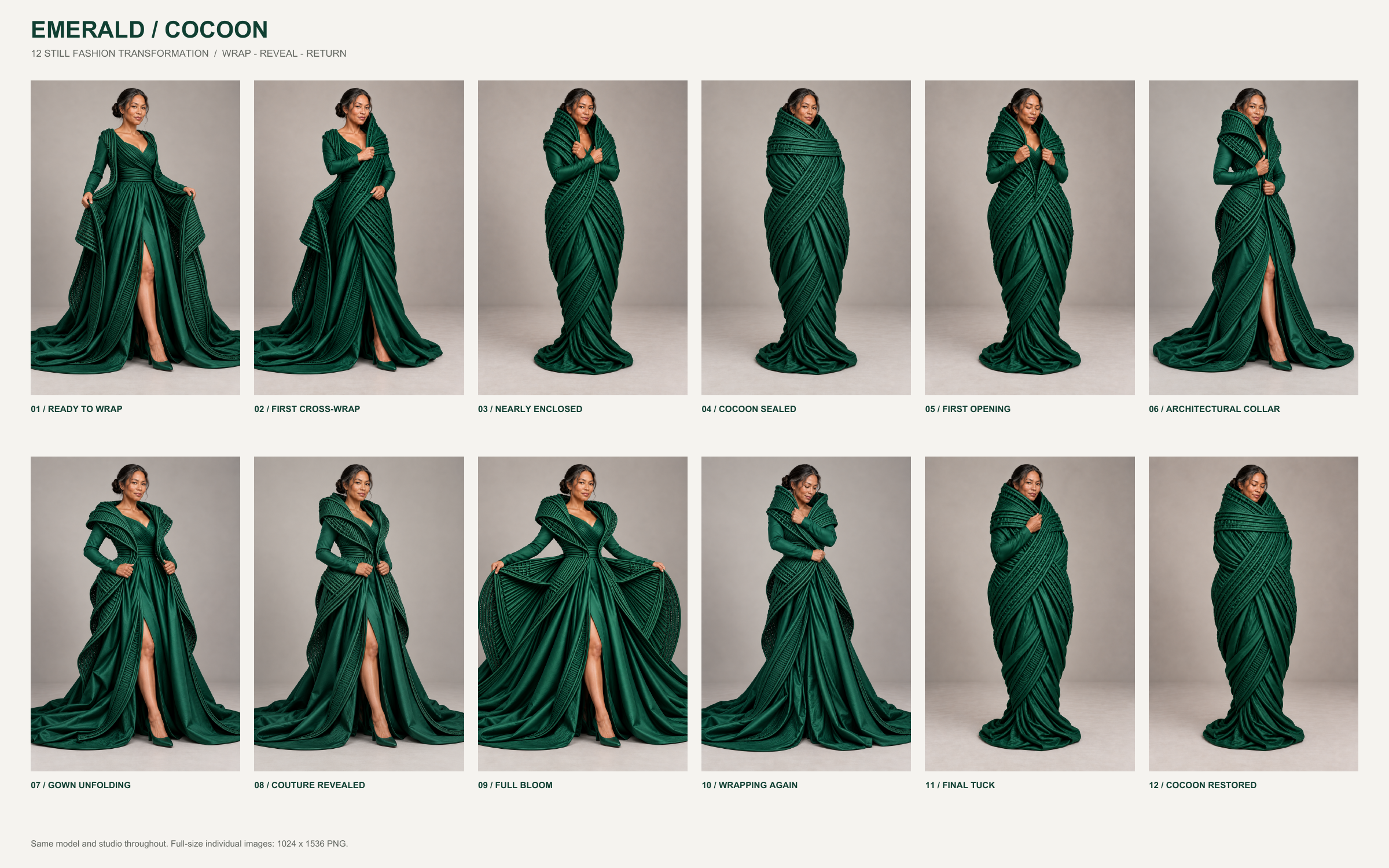
Open the twelve-stage storyboard
The original twelve-stage sequence. Produced AI-generated storyboard: wrap, enclosure, opening, display and return. Not a construction pattern.The original twelve-stage sequence ↗
The same synthetic identity and garment anchor were used across the key poses. Motion was then generated between start/end poses. A requested continuous garment is a design constraint, not a verified conservation-of-cloth result.

105 SECONDS / OPTIONAL SOUND

THE EXTENDED STUDY.

The longer wrap, reveal and return sequence.

Produced concept media. Motion and sound are generated, not recordings of a real garment.
How the film was put together

The 105-second edit uses all 20 generated takes and all 12 storyboard stills. Eleven corrected takes carry the main movement; nine earlier framing takes were reused as close details rather than claimed to be repaired.

After Effects supplied timing, type, chapter cues, short dissolves and gentle camera pushes. The 45-second cut selects passages from that composition. Existing generated movement audio was retimed, filtered and faded locally; no new music or voice was added to this edit.

The record supports an edited presentation. It does not establish that the depicted garment can execute the transformation in cloth.

02 / Silhouette · 4 TILES

HOLD THE FORM.

Gesture, wrap, release. Four ways into the silhouette.

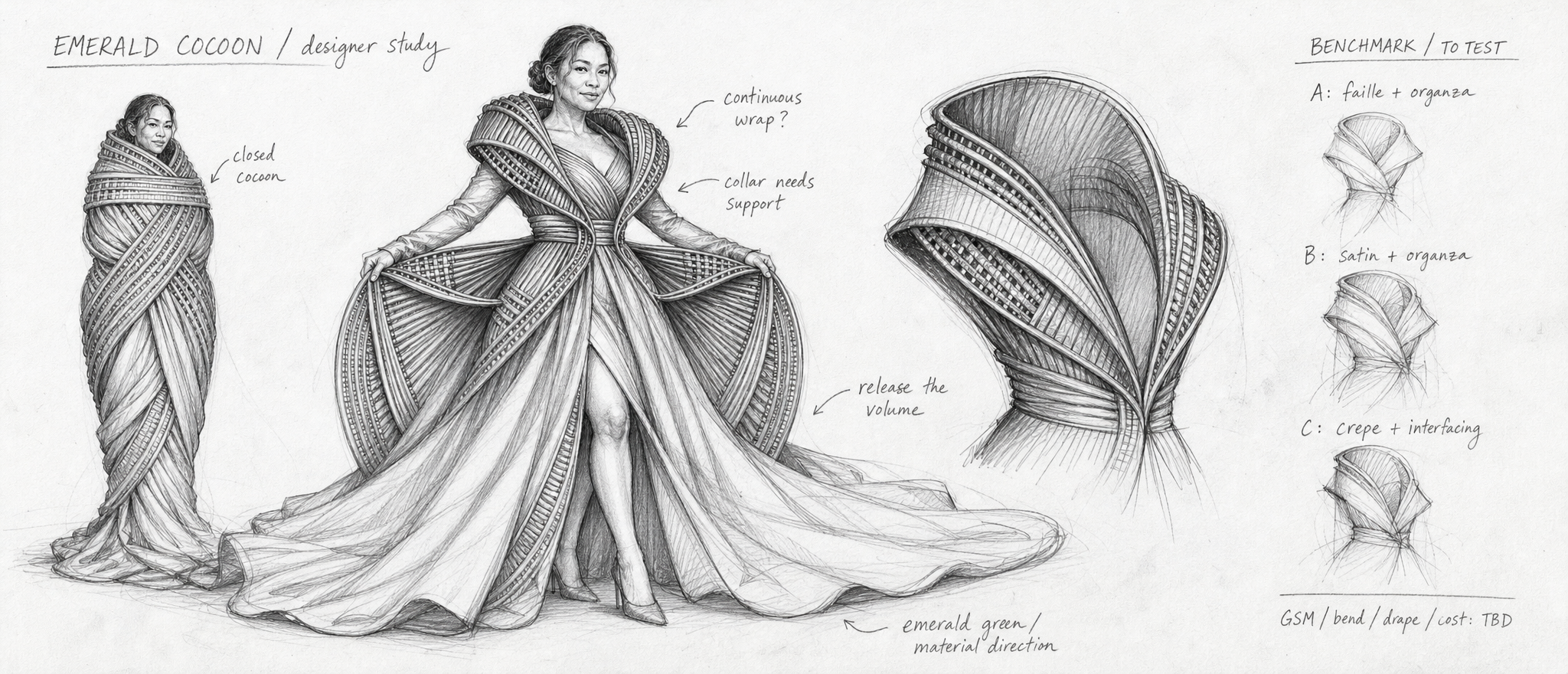
THE SILHOUETTE / DESIGNER STUDY

HOLD THE FORM.

A sculptural collar, an enclosed form and room to release the volume.

AI-generated retrospective exploration. Material pairings remain candidates to source and test.

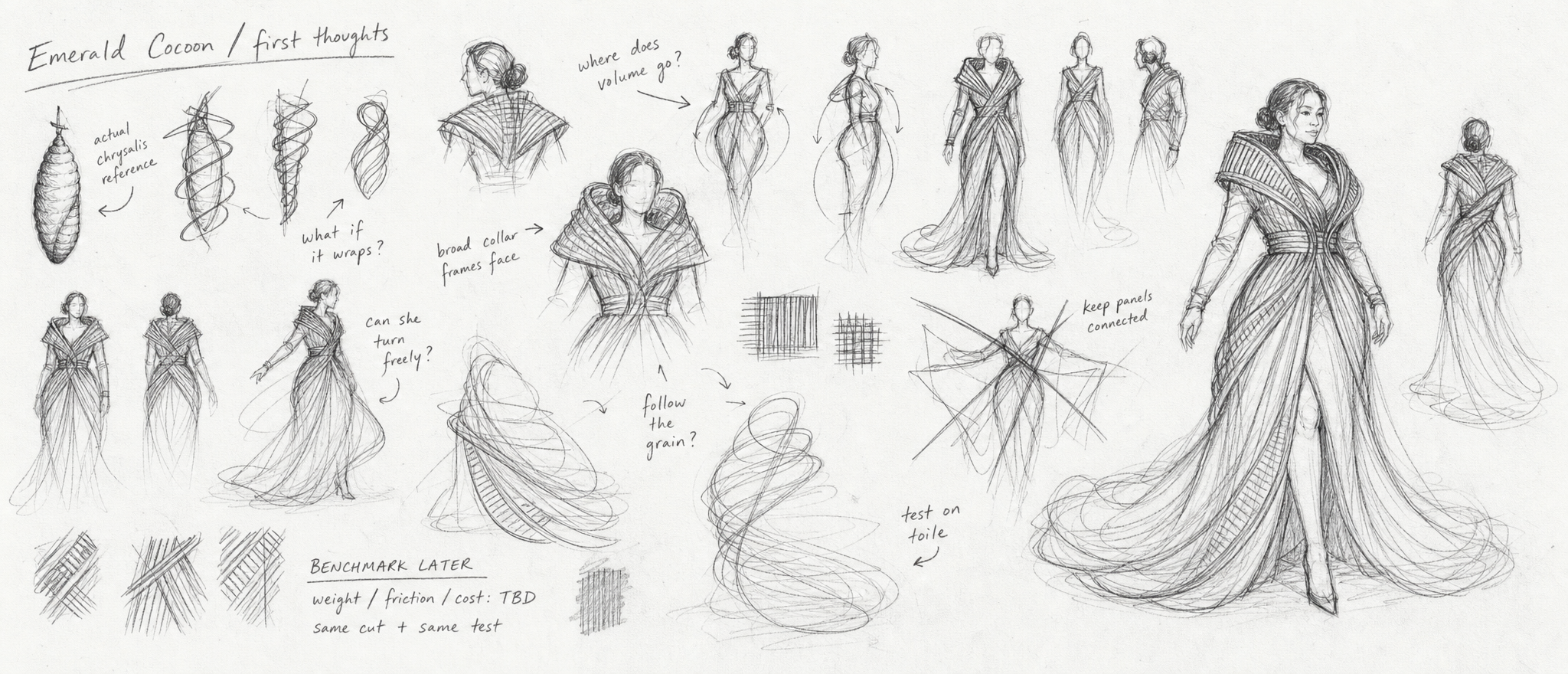
GESTURE / WRAP / RELEASE

REVISITING THE FORM.

Explore the silhouette through alternative gestures and fold routes.

AI-generated after the film. “First thoughts” is illustrated wording, not an original early hand drawing.

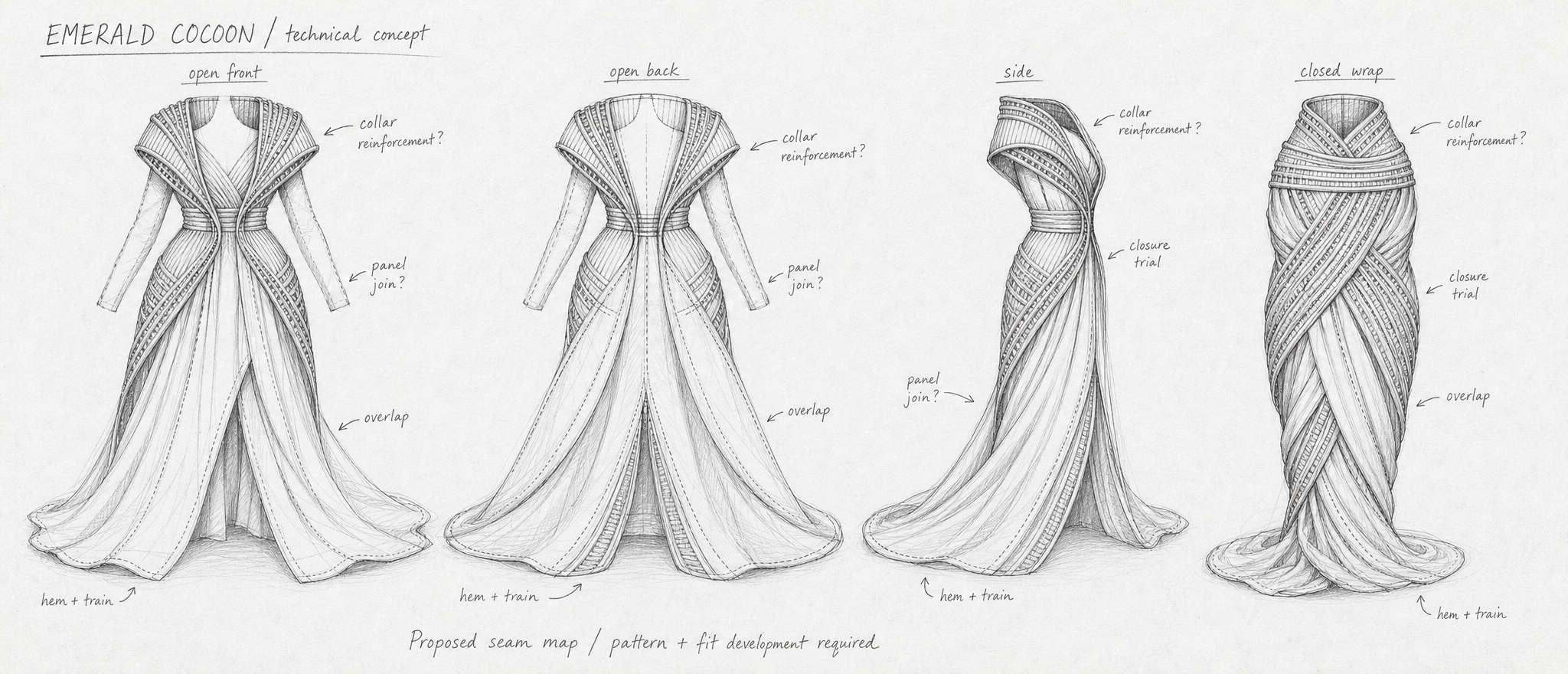
FRONT / BACK / SIDE / ENCLOSED

ONE IDEA. SEVERAL VIEWS.

Make imagined seams, overlaps and closures easier to discuss.

AI-generated concept views, not dimensioned technical flats or a verified sewing pattern.

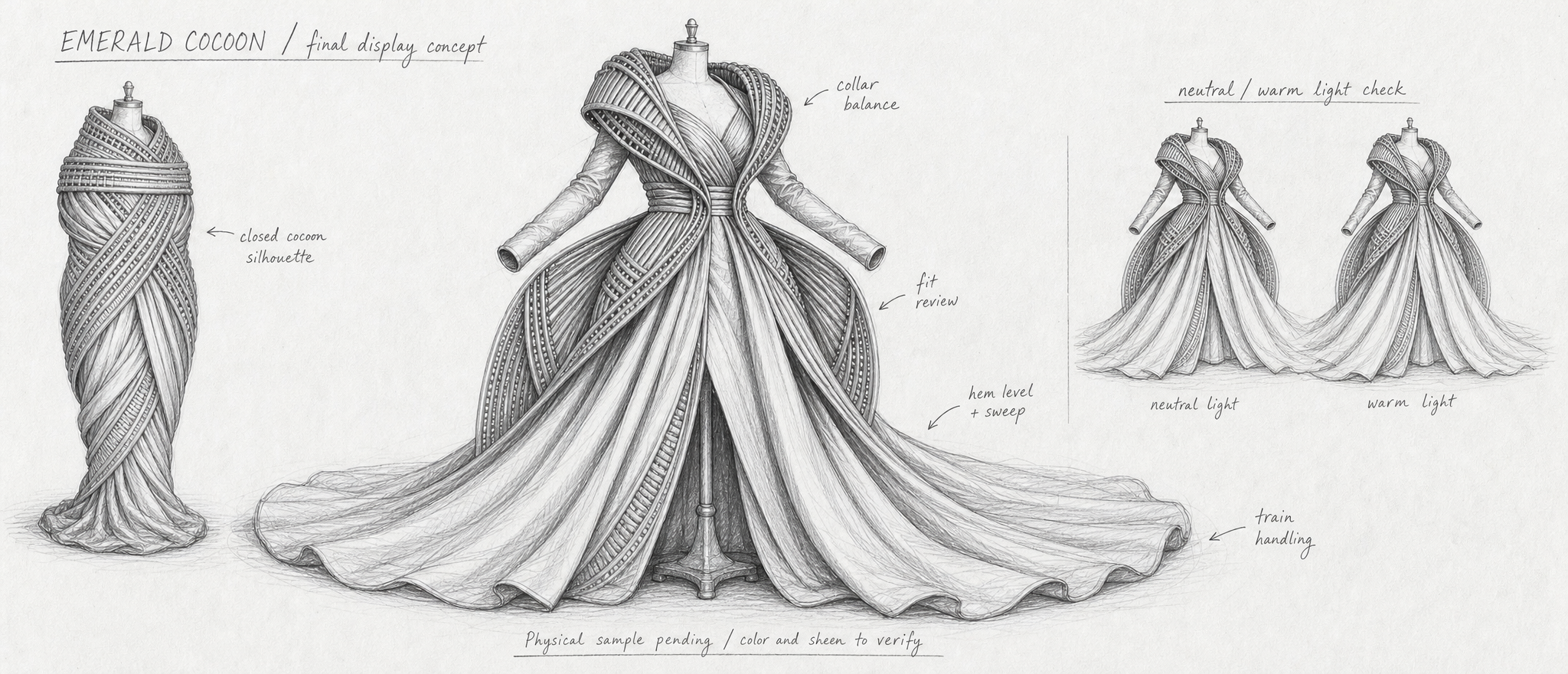
DRESS-FORM DISPLAY CONCEPT

THE INTENDED PRESENCE.

The open gown, enclosed cocoon and proposed display views.

AI-generated display proposal, not a manufactured garment. Physical fit, hem and lighting review remain pending.

03 / Making · 4 TILES

THE MAKING QUESTIONS.

Materials, construction, pattern and support—four studies for the next sample.

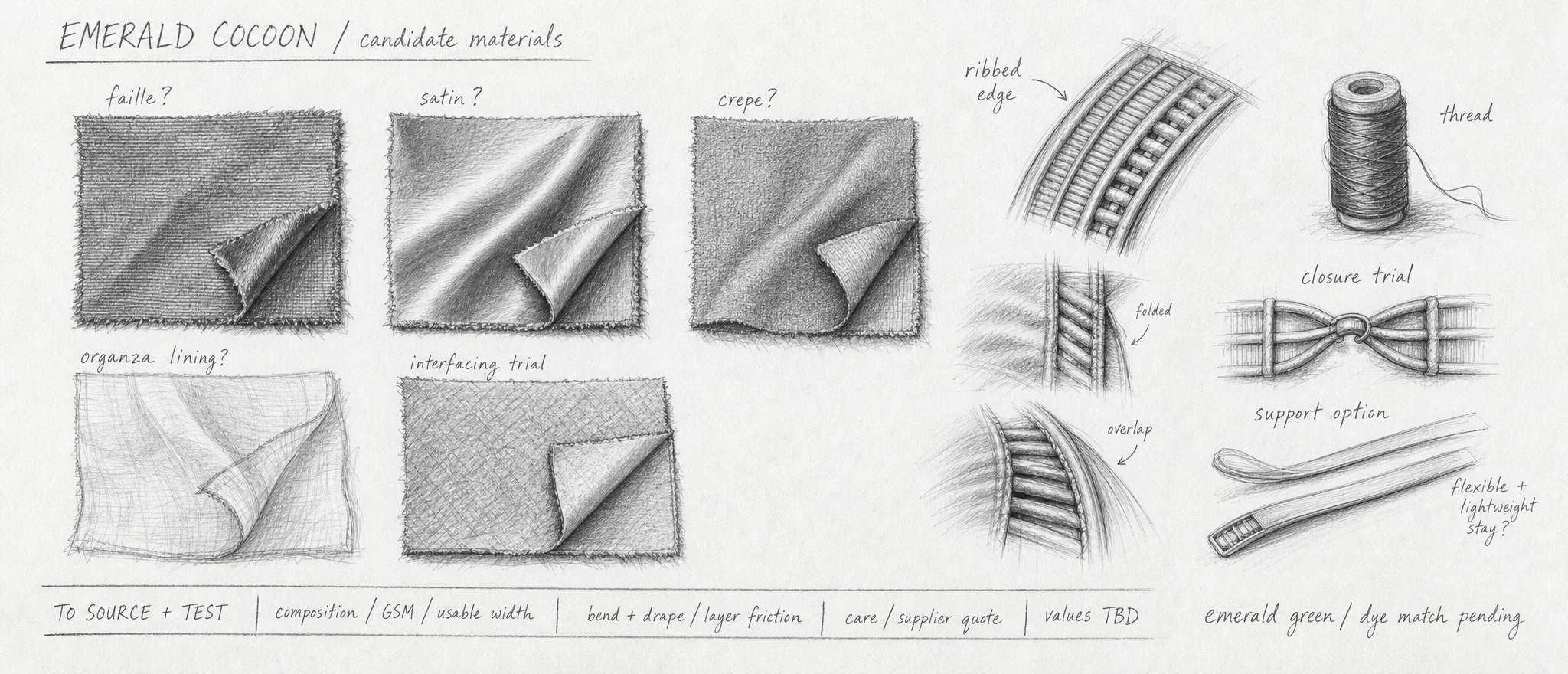
CANDIDATE MATERIALS + TRIMS

WHAT WOULD THE CLOTH DO?

Structure, drape, lining and ribbed edging become material questions.

AI-generated proposals. Real swatches, specifications, sources and quotes remain to be established.

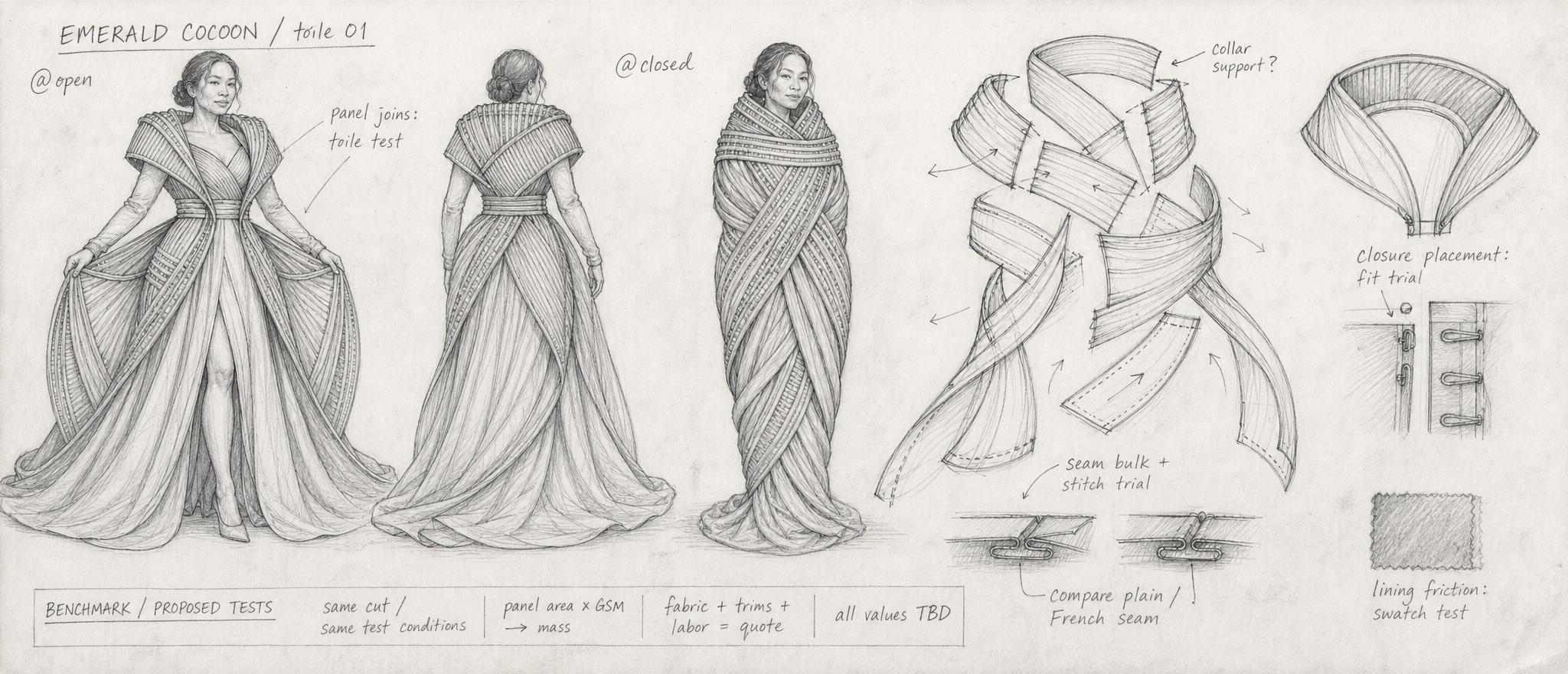
PANEL JOINS / COLLAR / CLOSURES

THE MAKING QUESTIONS.

Which parts need structure, and which need to fold freely?

AI-generated retrospective study. “Toile 01” is illustrative; no physical toile or construction test has been made.

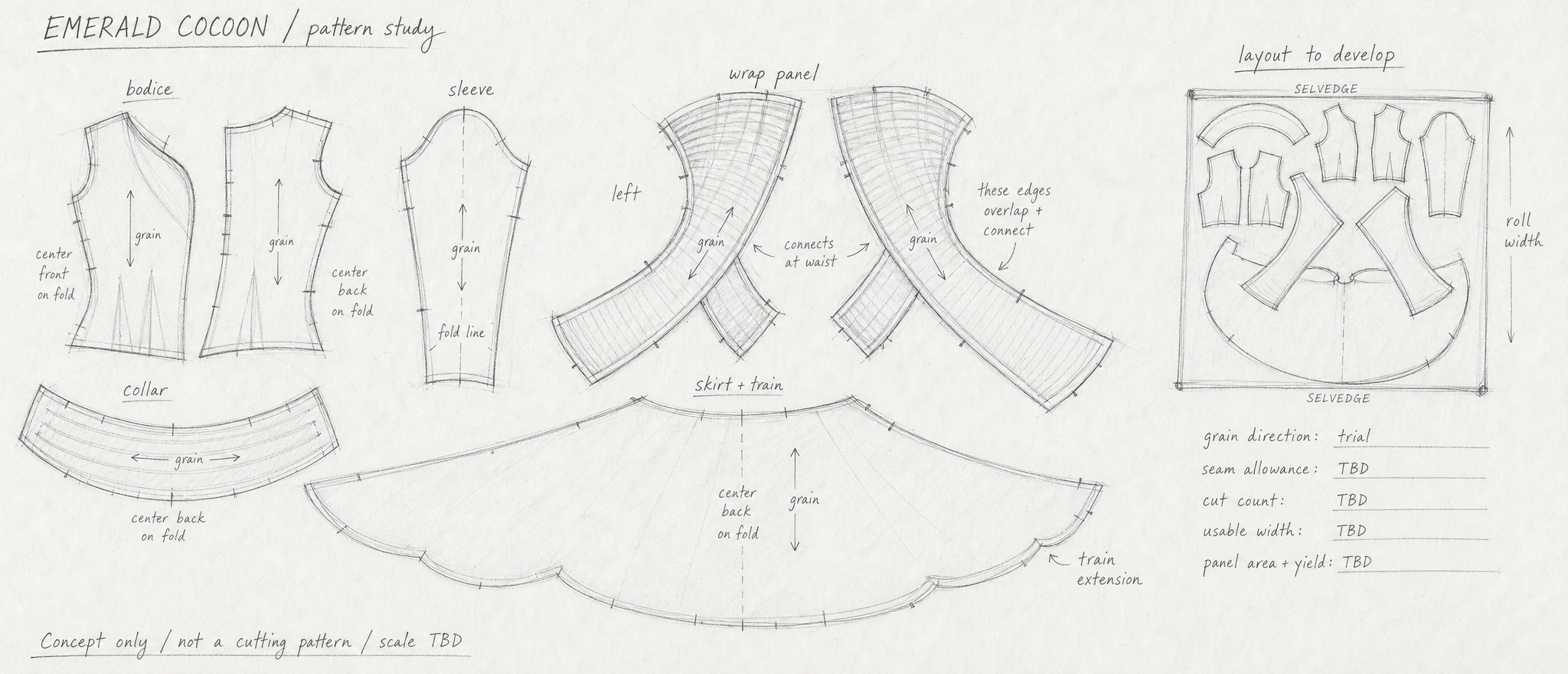
PATTERN + CUTTING-LAYOUT CONCEPT

FOLLOW THE PANEL.

Where would the fabric go when the silhouette closes?

AI-generated concept geometry, not a scaled cutting pattern. Fitting, grain and allowances require development.

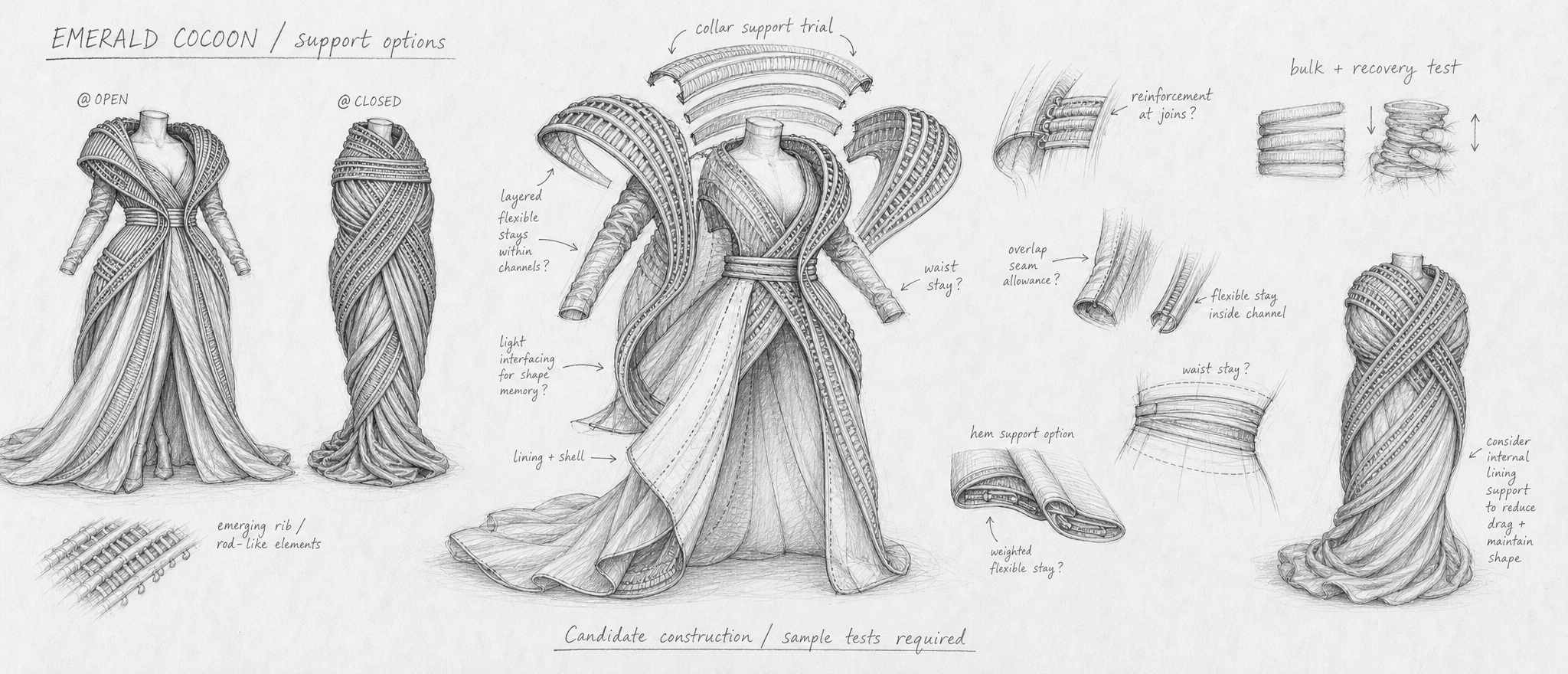
INTERNAL SUPPORT OPTIONS

HOLD. THEN RELEASE.

Collar stays, waist support and hem options frame the next sample questions.

AI-generated construction proposals. Material choices and physical sample trials remain open.

04 / Mechanics · 4 TILES

THE MECHANICS OF GRACE.

Cloth, air, folds and contact. Illustrations of questions to test—not measured results.

A CONCEPTUAL MODEL OF CLOTH

THE MECHANICS OF GRACE.

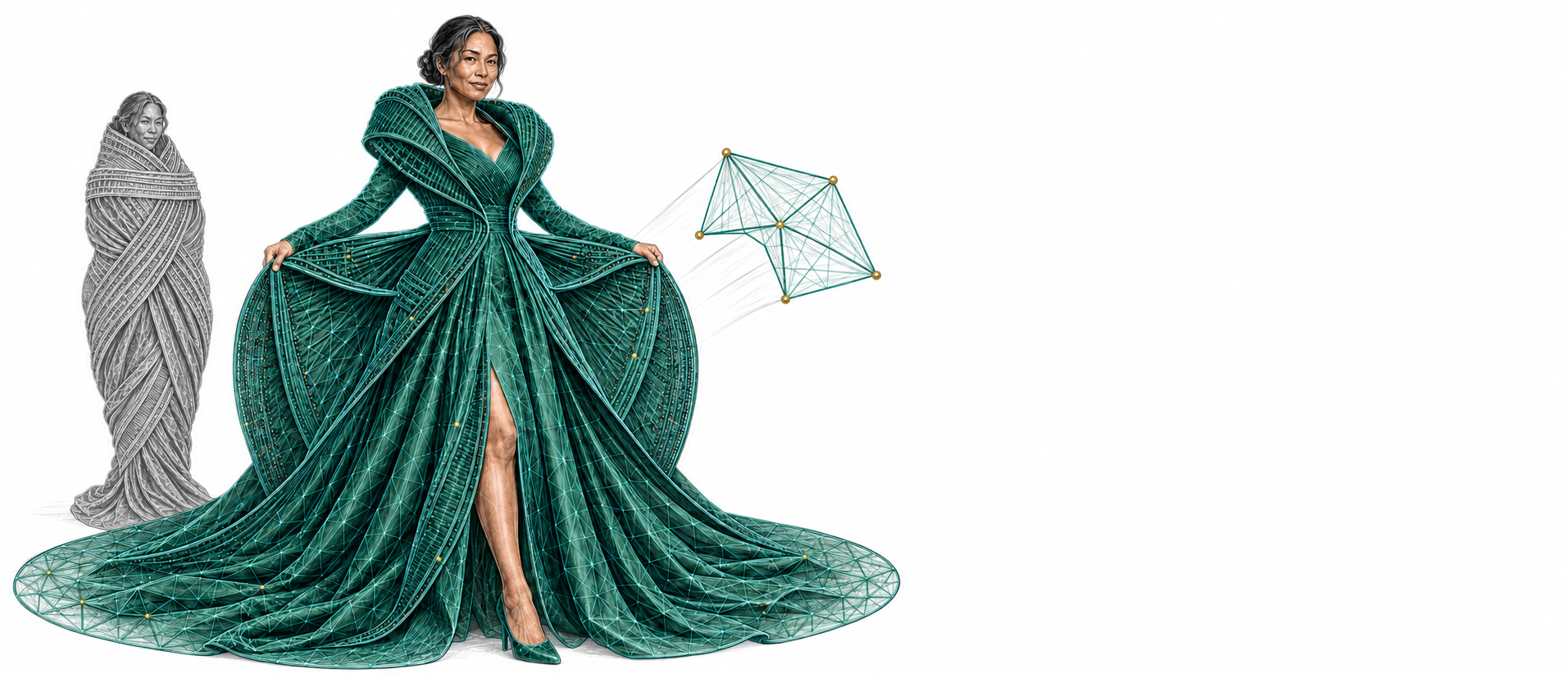
A mesh makes a computational idea visible.

AI-generated White Edition illustration. Not a solved garment model or validated physical transformation.

m ẍ + c ẋ + k x = 0

Teaching oscillator · cloth-simulation background

x is one displacement from rest, m mass, c damping and k stiffness. This is a one-coordinate teaching surrogate, not a whole-gown solver or an exact implementation of the cited paper. Cloth simulation requires many coupled coordinates, stretching, shear, bending, seams, contact and boundary conditions. The package contains an illustrated mesh, not an identified editable garment CAD/3D model or calibrated solver.

Baraff & Witkin — Large Steps in Cloth Simulation (1998), background ↗

SHAPE / RELATIVE MOTION / DRAG

AIR AND THE TRAIN.

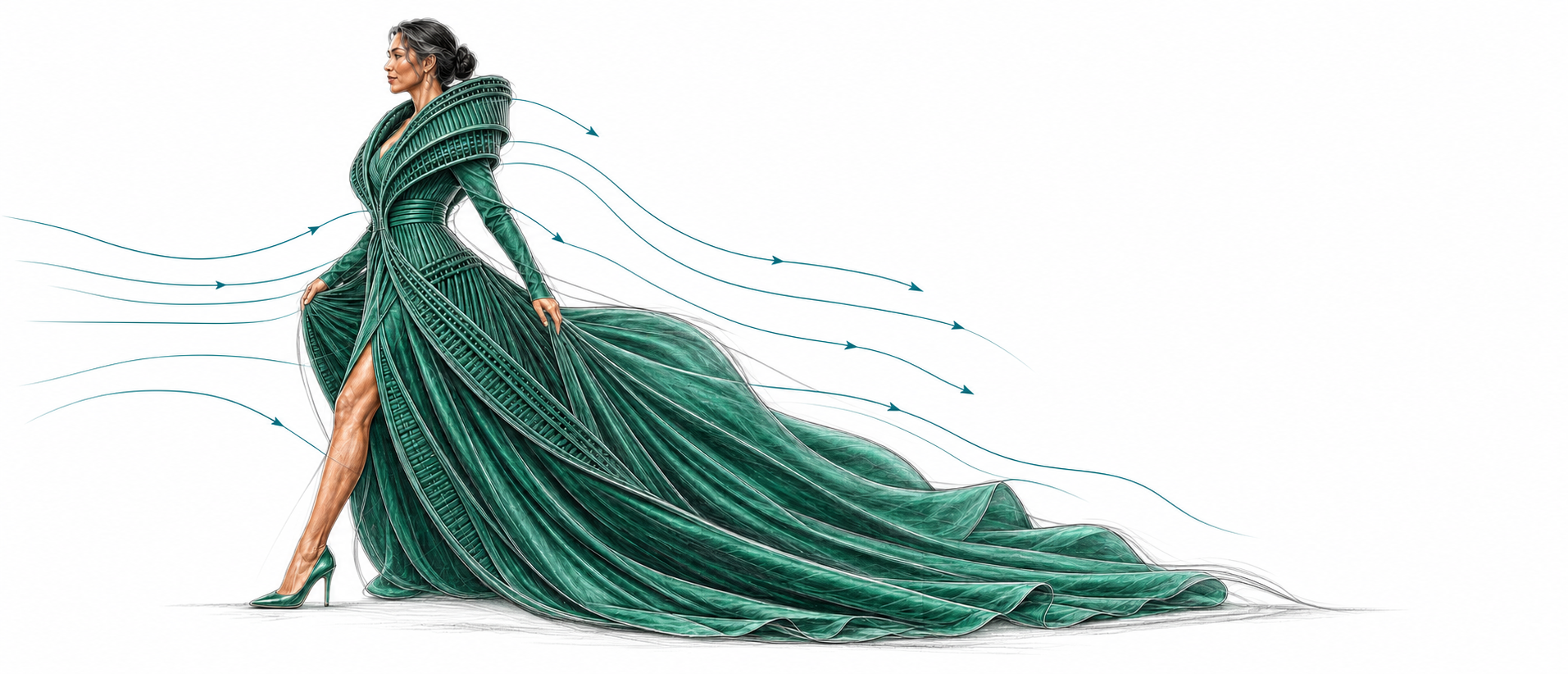
What would a useful comparison need to capture as the wearer moves?

Conceptual airflow paths, not a computed fluid field or a prediction of force on this gown.

F_D = ½ ρ v_rel² C_D A_ref

Drag model · NASA Glenn

ρ is air density; v_rel is relative air speed; C_D is tied to geometry and flow conditions; A_ref must be specified consistently. The illustration shows conceptual paths, not CFD. Doubling speed gives four times the modeled force only while density, coefficient and area stay fixed. No dress-specific force or drag coefficient has been measured.

NASA Glenn — Drag Equation ↗

CURVATURE + MATERIAL DIRECTION

THE GEOMETRY OF A FOLD.

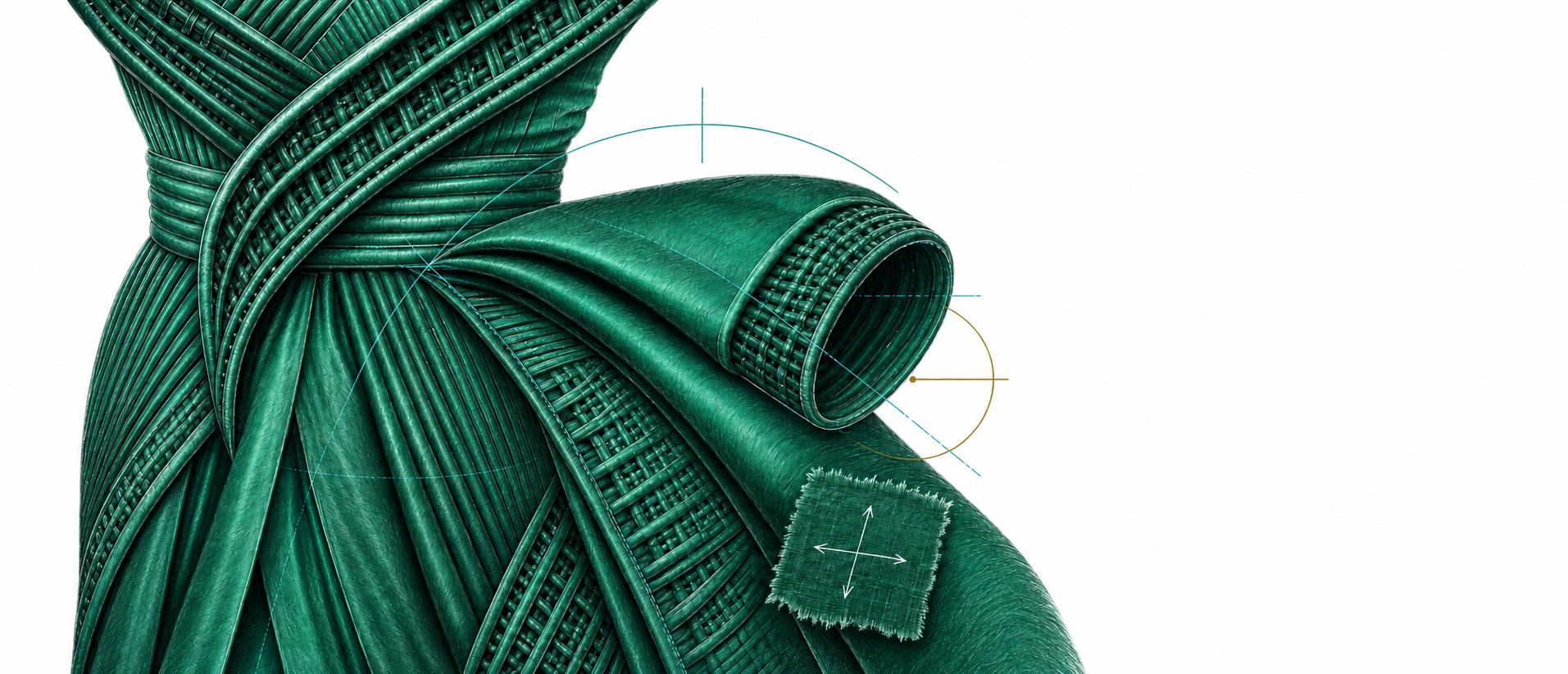
What would hold the fold, and what would let it relax?

AI-generated White Edition illustration. Directional properties, seams and supports still need measurements and trials.

u_b = B / (2R²)

Simplified bending · shell-model background

This is the project notes’ teaching reduction for an isotropic cylindrical fold with flat rest state and fixed bending rigidity B. R is fold radius. It is not a fitted woven-cloth law or an equation claimed verbatim from the cited paper. Woven direction, seams, supports, loads and contact need separate treatment. No B has been measured for this gown.

Grinspun et al. — Discrete Shells (2003), background ↗

CONTACT + HANDLING

WHERE THE HEM MEETS THE FLOOR.

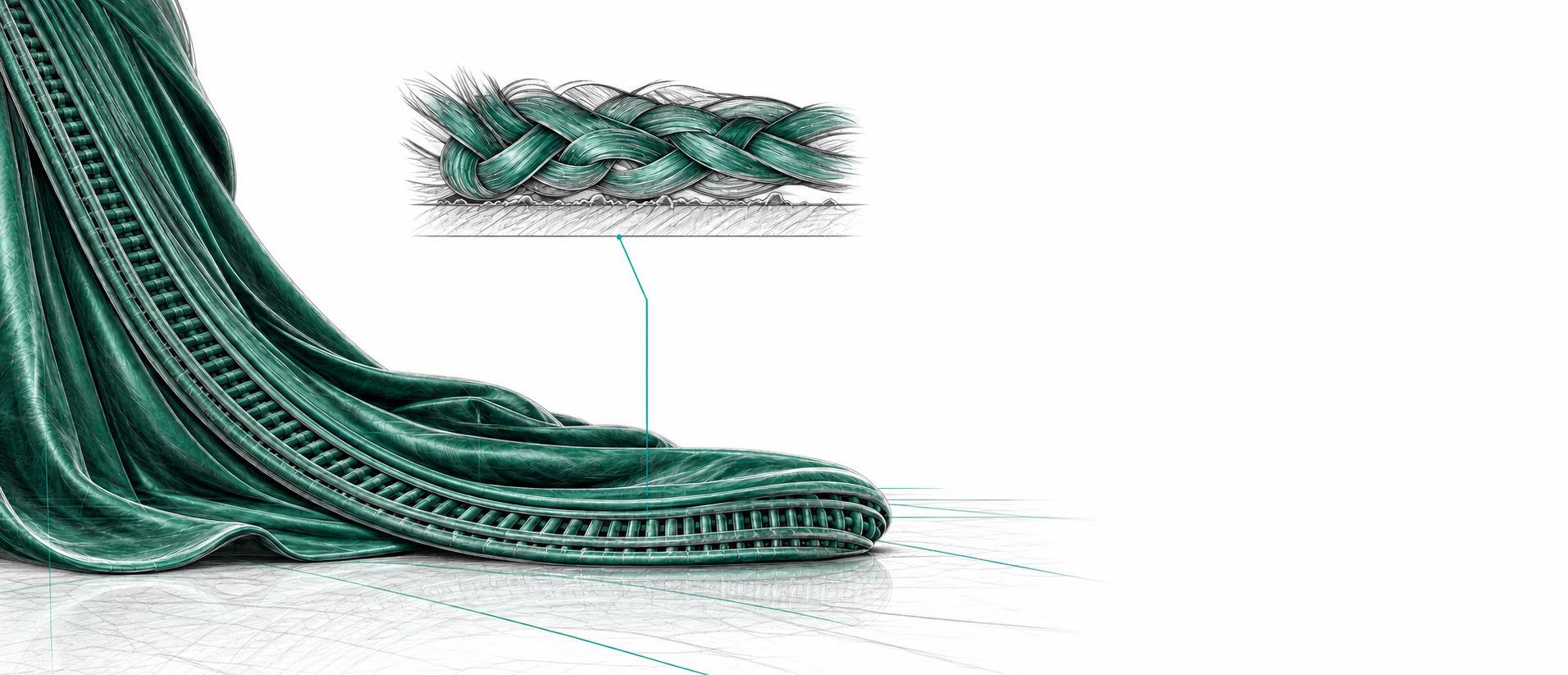
Consider the surface pair, supported load and the handling of the train.

Schematic concept detail, not microscopy, thermal imaging or a measured friction test.

F_f = μ_k N; P_loss = F_f v_slip

Sliding contact · OpenStax

μ_k belongs to the fabric–floor pair and the test conditions. N is the load carried by the contacting region, not automatically the weight of the whole dress. Friction opposes relative sliding; static contact instead allows F_s ≤ μ_s N. This power relation does not establish temperature or thermal comfort.

OpenStax — University Physics, Friction ↗
PROPOSED HEM STRATEGY / DISPLAY → MOVE → ENCLOSE

Design hypothesis, not a tested mechanism. Separate a controlled presentation pose from everyday movement. The film shows a train; it does not demonstrate dirt resistance, abrasion durability or a working lift.

01 / Presentation

Train extended on a controlled surface. The marked contact edge remains exposed to soil and wear.

02 / Movement

Propose hand gathering and a mechanical bustle/attachment to lift the train. Exact anchor, stride clearance and loads need a pattern and fitting.

03 / Enclosure

Propose a secured lower edge with room to walk and release. Keep any floor-contact surface away from the skin and clean inner dress.

New editorial schematics on white. Not CAD, dimensioned patterns, an automatic actuator or a depiction of a verified fold path. Dashed lines mark candidate contact/handling edges; no dimensions are specified.

Debris, cleaning and the physical tests

Air drag, floor friction, abrasive wear and soil pickup are different problems. Raising the train may reduce contact during movement; it cannot guarantee zero dirt or damage.

  • Map which side touches the floor and where it sits after wrapping. A dirty exterior must not fold against the wearer or clean lining.
  • Consider a removable protective hem facing as a candidate—not a selected textile, self-cleaning finish or completed construction.
  • Test a connected sample for catching, tripping, snagging, closure release, abrasion, soil retention and cleaning, before claiming a usable garment.

ASTM D4966: Martindale abrasion offers one relevant fabric-wear method; it does not alone certify a street-wear garment. AATCC TM130: oily-soil release after laundering addresses a specific cleaning outcome—not prevention of all dirt pickup. Public method scopes informed these test questions; no paid standard or test result is claimed.

05 / Contribution · 3 TILES

BEHIND THE SCENES.

The human decisions, generative tools, production code and next physical proof.

DIRECTION / PRODUCTION / NEXT PROOF

THE IDEA STAYS HUMAN.

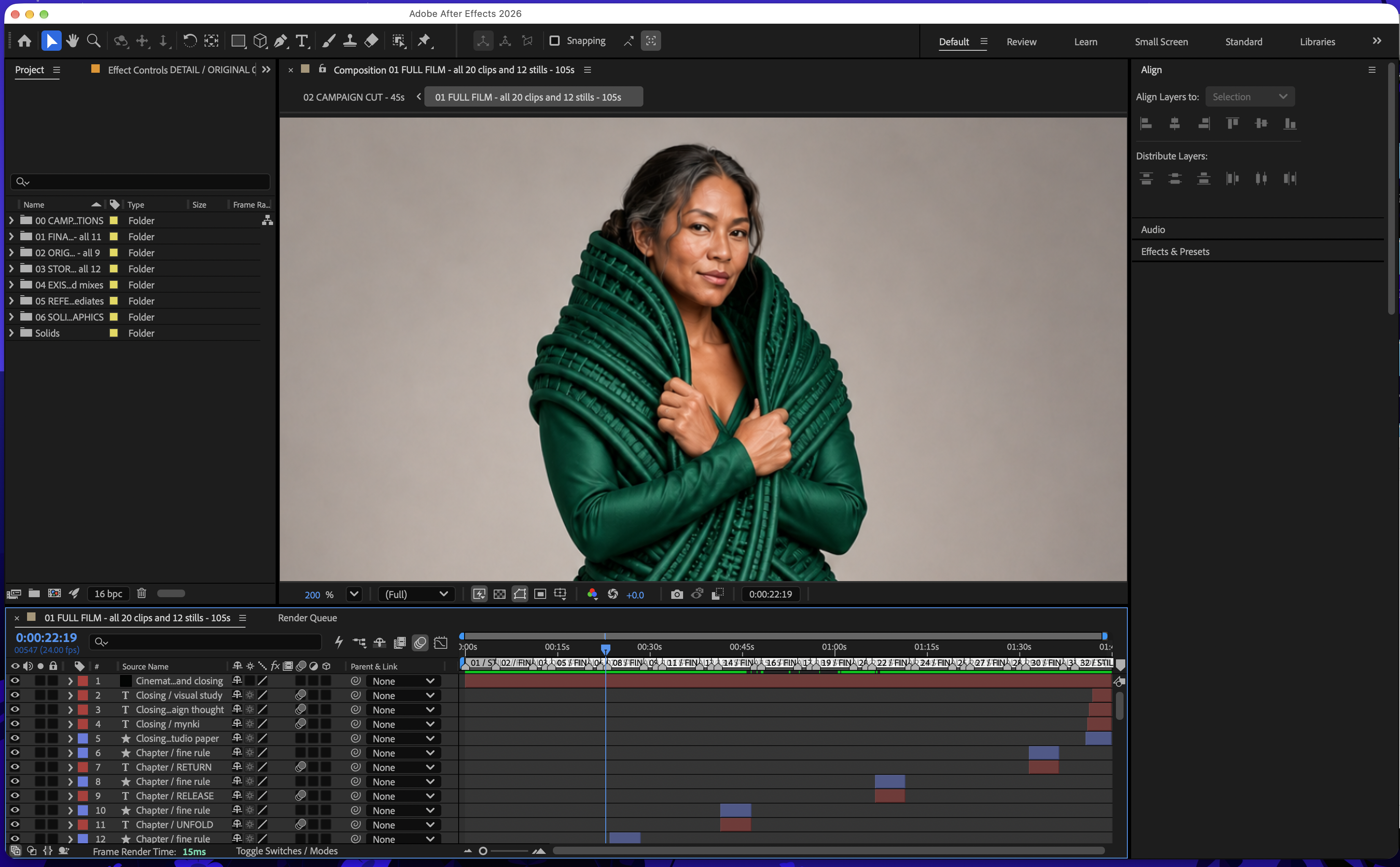
Inside the After Effects project. Supplied screenshot of the actual saved project, composition, imported sources and layer timeline. It demonstrates presentation assembly—not garment physics. Private title-bar text has been redacted; the composition and timeline remain visible.Inside the After Effects project ↗

Actual production screenshot · After Effects finishing

Human direction — the cocoon idea, visual references, emerald color, casting, movement and the protective/adaptive design ambition.

Generative tools — image_gen for key poses; Seedance 2 through Runway for motion. The studies are generated concept media.

AI-assisted coding + editing — Python/NumPy and FFmpeg for preparation, audio and encoding; ExtendScript for compositions, layers, timing and graphics in After Effects. This is collaborative implementation, not a claim that Samuel hand-coded every script.

A visual proposal and a more specific brief for making.

Produced concept media. Physical construction, garment-specific tests and manufacturing costs remain proposed.

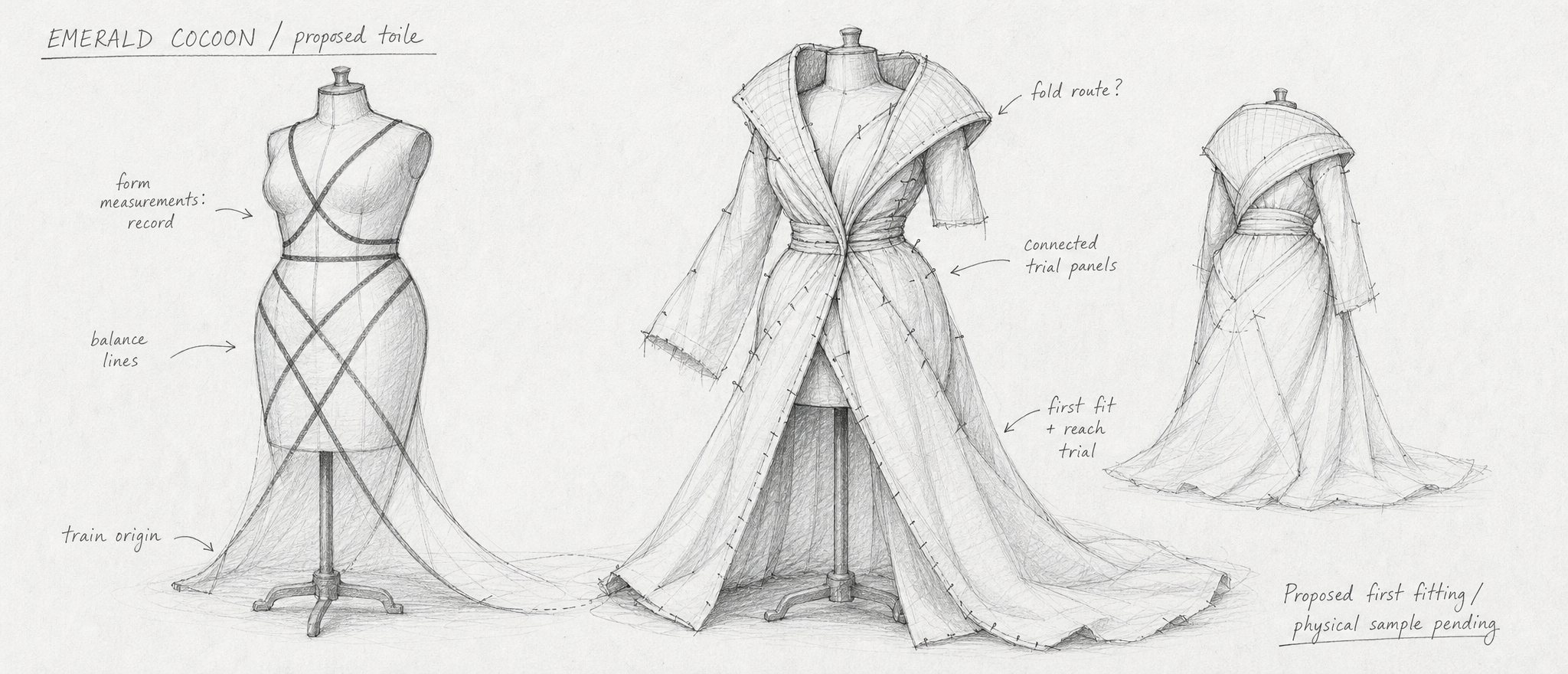
STYLE LINES + A PROPOSED TOILE

BEFORE THE FINAL CLOTH.

A possible first fitting stage, illustrated for discussion.

AI-generated proposal. No physical toile, padded form or wearer fitting has been made.

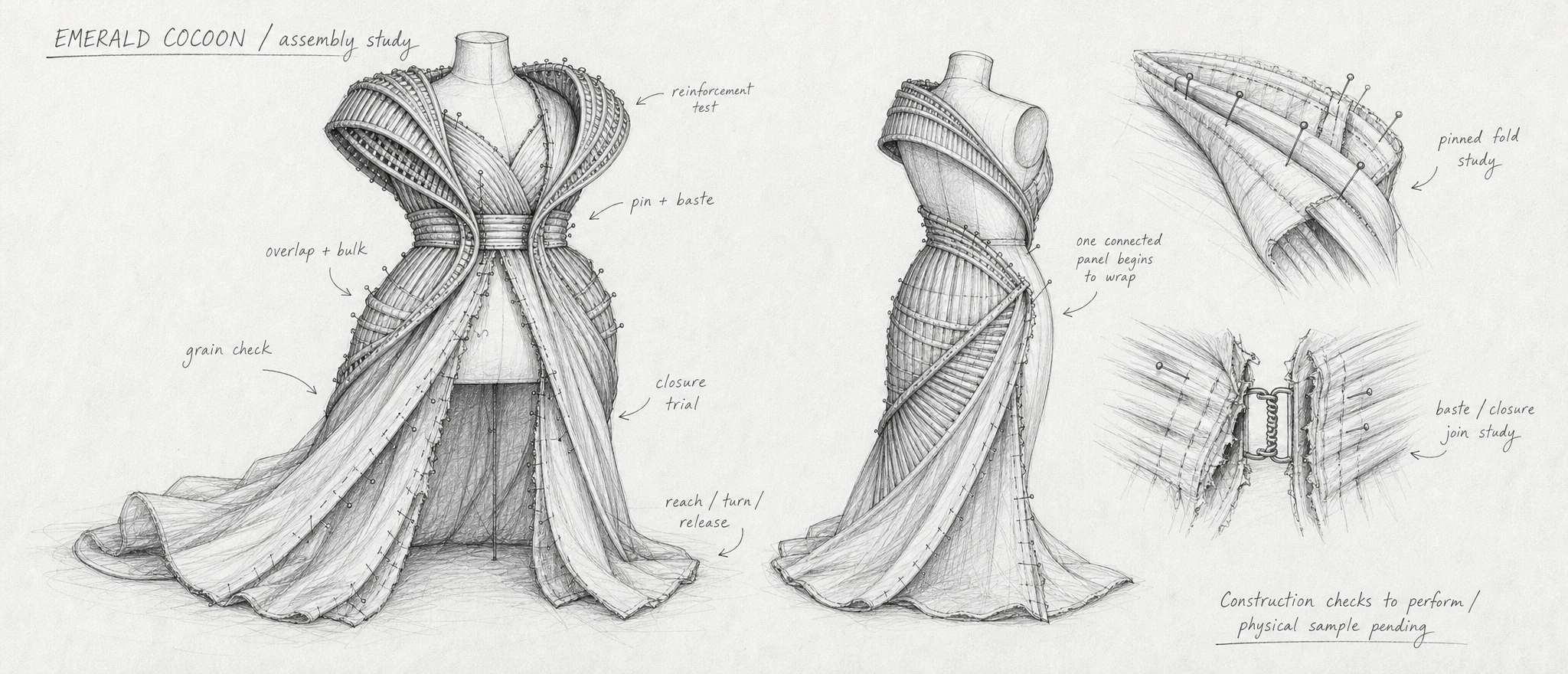
ASSEMBLY + FITTING EXPLORATION

WHERE THE PIECES MEET.

Examine overlap, bulk, grain alignment and closure access.

AI-generated illustration of checks to perform on a real sample, not completed assembly.

Study

Scroll sideways to inspect the full sheet on a smaller screen.

Direction, production and scope

From the first image to this presentation

  1. Set the human brief. Begin with the pupa image, combine collar and long-silhouette references, choose emerald, casting and a wrap–reveal–return behavior.
  2. Make twelve key poses. Generate a shared synthetic identity/garment anchor and review enclosure, first opening, collar, gown and return states.
  3. Generate and review motion. Use start/end anchored video generations. Keep continuity and material behavior open to inspection instead of treating plausible movement as simulation.
  4. Build the film. Script an editable After Effects project; sequence all 20 takes and 12 stills into the longer film, select a shorter cut, add typography, transitions and existing audio treatment, then render and encode locally.
  5. Revisit the making. Generate the pencil-style studies after the film. Write a material/construction brief and an explanatory mechanics chapter with named sources.
  6. Define the next proof. Select materials and a response architecture, make connected patterns and a physical sample, and compare movement, protection, fit and comfort with the stated design targets.

Where coding enters

The supplied Python preparation script builds an explicit edit plan, checks source counts, prepares audio and writes a usage map. After Effects ExtendScript imports footage and builds compositions, layers, time remapping and graphics. FFmpeg performs local media preparation/encoding. No garment-control code, embedded AI, calibrated cloth solver or editable garment CAD model was identified in the supplied package.

// Excerpt from the supplied After Effects build; formatting simplified.
var main = comp('01 FULL FILM - all 20 clips and 12 stills - 105s', 1080, 1620, 105);
for (var i = 0; i < P.events.length; i++) {
  var e = P.events[i], item = imported[e.path], l = main.layers.add(item);
  // Timing, source selection and graphic layers follow the edit plan.
}

What AI contributes today

Visual iteration, a consistent set of key poses, generated motion, retrospective study illustrations, explanatory writing and assisted production code. It helps make a direction inspectable and a development brief explicit. It has not replaced textile selection, pattern cutting, sewing, wearer testing or validated mechanics.

Why this is more than a technology label

The human brief asks a specific fashion question: can an expressive inner silhouette become its own protective outer layer? Each making question has a physical consequence—collar support, gathered bulk, seam friction, wearer movement, thermal/moisture response and skin comfort. The current result is a visual proposal and a development agenda, not a demonstrated smart-fabric product.

Reading the evidence

The pencil sheets are AI-generated retrospective studies. The fabric and sewing photos are supplied references, not selected swatches or the project’s workshop. Physics links explain established models; they do not certify this garment. Supplied references are distinguished from the project’s generated studies and actual production screenshot. Global priority, market demand, manufacturing readiness, environmental protection and irritation-free comfort have not been established.